
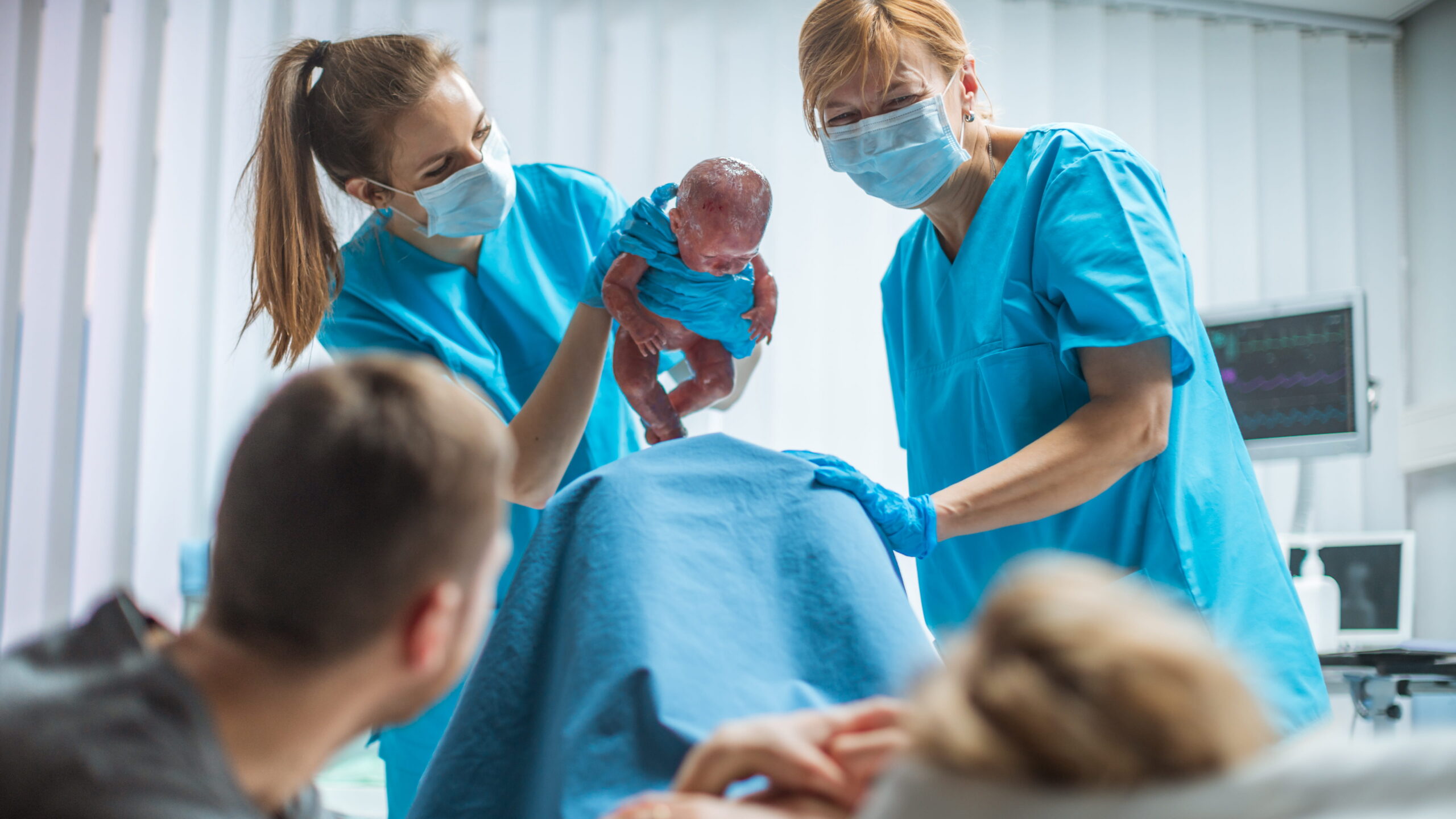
The United States recorded 3,628,934 births in 2024, according to the Centers for Disease Control and Prevention’s National Center for Health Statistics. Labor and delivery (L&D) nurses monitor mothers and babies, support patients throughout labor, assist with vaginal and cesarean deliveries, and care for mothers and newborns after birth.
Registered nurses (RNs) considering maternal care can build relevant clinical judgment, communication, and leadership skills through a Bachelor of Science in Nursing (BSN) program. Nevada State University’s RN to BSN online program helps working nurses expand those capabilities as they prepare for increasingly complex patient care.
What Do Labor and Delivery Nurses Do?
Labor and delivery nurses monitor maternal and fetal health, support labor, assist during birth, respond to complications, and care for mothers and newborns immediately afterward. Their work spans the antepartum period, or the time before birth; the intrapartum period, which includes labor and delivery; and the postpartum period after birth.
The specialty blends elements of emergency nursing, critical care, operating room practice, and patient education. L&D nurses may need to interpret a fetal heart tracing, prepare quickly for surgery, help manage pain, and explain each development to a patient and family, sometimes within the same hour.
Because L&D nurses often spend more hands-on time with laboring patients than anyone else on the care team, they may be the first to notice a change in the mother or fetus. Their continuous presence supports timely assessment and escalation when concerns arise.
Labor and Delivery Nurse Job Description
The labor and delivery nurse job description follows the patient’s journey from arrival through recovery and discharge. Common responsibilities include:
- Assessing patients upon arrival to determine the stage of labor.
- Interpreting electronic fetal heart monitoring (EFM) strips to identify signs of fetal distress.
- Administering medications, including oxytocin for labor augmentation.
- Observing maternal vital signs, including blood pressure and temperature.
- Assisting in the management of epidural or other pain relief measures.
- Guiding the patient through various labor positions to assist in fetal descent.
- Encouraging communication and coordination between the patient and the obstetrician or midwife.
- Preparing patients and equipment for cesarean deliveries and assisting with care in the operating room.
- Watching for complications such as postpartum hemorrhage.
- Conducting initial neonatal assessments and supporting skin-to-skin contact.
- Providing comprehensive discharge instructions on recovery and newborn care.
Safe care also depends on appropriate staffing. AWHONN’s staffing standards call for a 1-to-1 nurse-to-patient ratio when oxytocin is initiated and during labor with medical or obstetric complications. In postpartum care, the recommended maximum is three couplets, meaning three mothers and their three newborns, per nurse. These standards help nurses maintain the surveillance needed to recognize changes and respond promptly.
Where Labor and Delivery Nurses Work
Most L&D nurses work in hospital birthing units, where they may rotate through obstetric triage, antepartum care, active labor, the operating room (OR), and recovery. This rotation allows nurses to support patients across several stages and levels of acuity.
Other settings include freestanding birth centers and maternal-fetal medicine clinics, where nurses may assist patients with high-risk pregnancies. Experienced L&D nurses may also move into adjacent roles in education, quality improvement, or administration.
Because childbirth does not follow a fixed schedule, many L&D positions involve nights, weekends, holidays, and other shifts needed to provide 24-hour coverage.
How to Become a Labor and Delivery Nurse
Learning how to become a delivery nurse involves completing a nursing degree, obtaining RN licensure, gaining clinical experience, and developing specialty knowledge. The steps below explain how to become a labor and delivery nurse and prepare for this area of practice.
Step 1: Earn a Nursing Degree
Prospective RNs may earn either an Associate Degree in Nursing (ADN) or a BSN to qualify for licensure. The U.S. Bureau of Labor Statistics (BLS) lists a bachelor’s degree as the typical entry-level education for RNs, although graduates of approved associate degree and diploma programs may also qualify for entry-level positions. Nurses comparing the two pathways can review the key differences between an ADN and a BSN.
Step 2: Pass the NCLEX-RN
After completing an approved nursing program, candidates must pass the NCLEX-RN to obtain RN licensure. Nurses must meet their state’s requirements to obtain and maintain licensure, while many RN to BSN programs also require applicants to hold an active, unencumbered RN license.
Step 3: Gain Clinical Experience
Some new graduates enter L&D directly through a nurse residency program. Others transfer into the specialty after gaining experience in postpartum, mother-baby, or medical-surgical nursing.
Once hired into an L&D unit, nurses typically complete a preceptorship with an experienced clinician. The length and structure vary by facility, but the process provides supervised experience with fetal monitoring, labor support, emergency response, and unit procedures.
Step 4: Add Specialty Training and Certification
The Neonatal Resuscitation Program (NRP) from the American Academy of Pediatrics is a common requirement for nurses who care for newborns at delivery. Nurses may also pursue the following credentials from the National Certification Corporation (NCC):
- Inpatient Obstetric Nursing (RNC-OB): Candidates must hold an active RN license, have 24 months of specialty experience, complete at least 2,000 hours in the specialty, and have been employed in the specialty at some point within the past two years. Both the practice time and hour requirements must be met.
- Electronic Fetal Monitoring (C-EFM): This credential has no minimum practice-hour requirement, making it a practical starting certification for nurses who want to demonstrate fetal monitoring knowledge.
Step 5: Complete Your BSN
For ADN-prepared nurses, completing an RN to BSN program can strengthen their competitiveness and open doors to charge nurse, educator, and leadership roles. The degree builds on existing clinical experience while expanding preparation in research, population health, and organizational practice.
How a BSN Prepares You for Maternal Care
Maternal care requires nurses to interpret ambiguous data, escalate concerns clearly to physicians and other clinicians, teach new parents, and advocate when a patient’s symptoms have been overlooked or dismissed. AWHONN’s staffing standards executive summary notes that delays in recognizing and responding to warning signs are associated with preventable maternal harm, making timely clinical judgment a patient safety priority.
Nevada State University’s RN to BSN curriculum builds knowledge in evidence-based practice, caring science, leadership, community health, and cultural awareness. The program concludes with an immersion experience that gives students an opportunity to integrate what they have learned.
Key Skills Developed in a BSN Program
A BSN program can help nurses develop the following capabilities:
- Evidence-based practice and research literacy
- Clinical reasoning under uncertainty
- Leadership and interprofessional communication
- Patient education and health promotion
- Cultural competence and health equity awareness
- Quality improvement and patient safety methods
In L&D practice, these skills support careful interpretation of fetal monitoring strips, rapid escalation when a mother or fetus shows signs of distress, and clear discharge teaching about postpartum warning signs. They also help nurses communicate across disciplines while keeping the patient and family informed.
Labor and Delivery Nurse Salary and Job Outlook
The BLS does not report wages specifically for labor and delivery nurses. For RNs overall, the median annual wage was $93,600 in May 2024, and the top 10 percent earned more than $135,320. The median for RNs working in hospitals was $97,260, and hospitals employed about 59 percent of RNs. These figures provide broader context but do not guarantee earnings in a particular specialty, role, or location.
The BLS projects 5% employment growth for RNs from 2024 to 2034, which is faster than the average for all occupations. It also projects about 189,100 openings each year, on average, during that period.
Demand for maternity nurses also reflects the range of care required during birth. In 2024, the national primary cesarean delivery rate was 22.9%, sustaining the need for nurses with OR and recovery competencies as well as labor-support skills.
Is Labor and Delivery Nursing Right for You?
L&D nursing includes joyful moments, but it also requires clinicians to respond to hemorrhage, fetal distress, pregnancy complications, and loss. Nurses in this specialty must be prepared for rapid changes and emotionally difficult outcomes without losing sight of each patient’s immediate needs.
The role may suit nurses who remain steady under pressure, feel comfortable escalating concerns, and are energized by teaching patients and families. Strong observation, communication, and teamwork are as important as an interest in pregnancy and birth.
For nurses with that temperament, maternal care can offer meaningful opportunities to support families through pivotal moments. It is a nursing specialty in which skilled, compassionate care can shape both safety and the patient experience.
Prepare for Maternal Care With Nevada State University
Labor and delivery nursing rewards the same abilities a BSN helps nurses strengthen: evidence-based judgment, clear communication, leadership, and patient advocacy. For RNs drawn to maternal care, continued education can support both effective bedside practice and future professional growth.
Nevada State University’s RN to BSN online program is 100% online and can be completed in as little as 12 months for a total tuition of under $11,000. The program is accredited by the Commission on Collegiate Nursing Education (CCNE) and is designed for working nurses.
Ready to take the next step? Request more information about Nevada State University’s RN to BSN online program.
Sources
https://www.cdc.gov/nchs/products/databriefs/db535.htm
https://www.awhonn.org/resources-and-information/published-resources/staffing-exec-summary/
https://www.bls.gov/ooh/healthcare/registered-nurses.htm
https://www.aap.org/en/pedialink/neonatal-resuscitation-program/
https://www.nccwebsite.org/certification-exams/details/2/inpatient-obstetric-nursing
https://www.nccwebsite.org/certification-exams/details/1/electronic-fetal-monitoring