
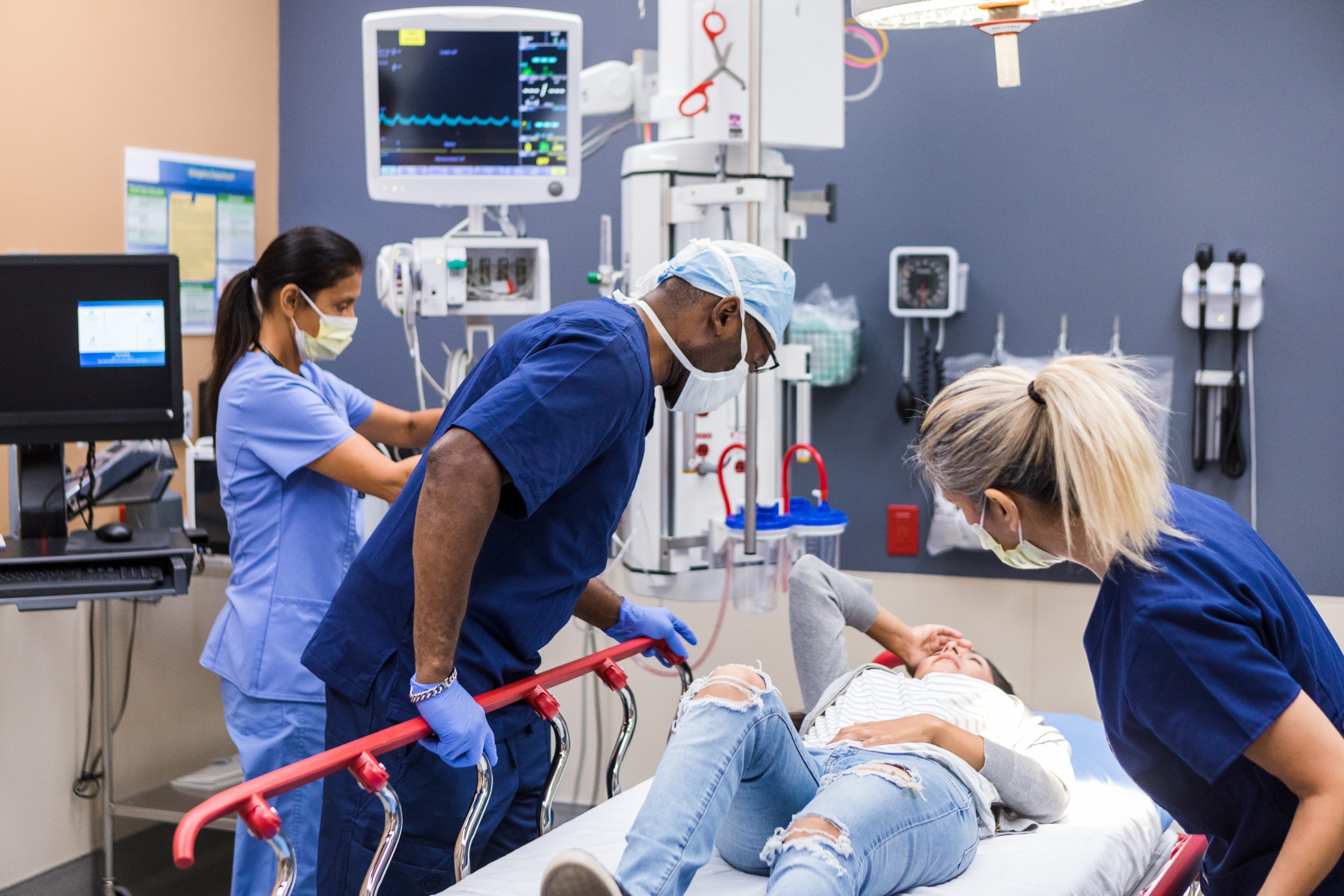
Emergency departments never quite know what’s coming next: a broken wrist, a heart attack, a child running a fever that won’t break. The nurses who staff these units have to be ready for almost anything, often within seconds of a patient’s arrival. If you’re trying to figure out how to become an ER nurse, the path runs through earning your RN license, building hands-on clinical experience, and completing a BSN, which is increasingly the expectation rather than the exception. This guide breaks down what the role actually involves and how Nevada State University’s online RN to BSN program can help working nurses get there.
What Is an ER Nurse?
An ER nurse is a licensed, registered nurse who provides urgent and acute care inside a hospital’s emergency department. Unlike nurses working in a single specialty unit, ER nurses treat patients of every age and every condition, often with little to no warning about what’s about to come through the ambulance bay doors.
On a typical shift, ER nurses are responsible for:
- Triaging patients based on the severity of their condition
- Performing rapid assessments to identify life-threatening issues
- Administering medications and carrying out emergency procedures
- Documenting patient status and changes in real time
- Coordinating care with physicians, specialists, and support staff
- Educating patients and families on next steps and discharge instructions
What sets ER nursing apart from other specialties is the pace. These nurses have to prioritize on the fly, communicate clearly under pressure, and apply sound clinical judgment to situations that rarely come with a script.
ER Nurse Job Requirements: What You Need to Get Started
Getting into emergency nursing takes more than passing a licensing exam. Hospitals want nurses who can think on their feet, work well under pressure, and hold certifications that prove they’re ready for high-acuity care. Understanding how to become an emergency room nurse means knowing the order these pieces come in, from your initial degree through specialty certification. Here’s what that path looks like, step by step.
Step 1: Earn a Nursing Degree
Both an Associate Degree in Nursing (ADN) and a Bachelor of Science in Nursing (BSN) make graduates eligible to sit for the NCLEX-RN and pursue RN licensure. ADN programs generally take two to three years to complete, while BSN programs take about four. The degree you choose matters; many hospitals, especially larger facilities and academic teaching hospitals, now prefer or outright require BSN preparation for emergency department roles. ADN-prepared nurses who want to meet that bar often go back for an RN to BSN program to round out their credentials without starting nursing school over.
Step 2: Pass the NCLEX-RN
The NCLEX-RN is the standardized, computer-adaptive exam every nursing graduate must pass to become licensed. It tests clinical judgment and safe practice across the full scope of nursing care, not just emergency medicine. Once you’ve passed the exam and met your state’s licensure requirements, you’re officially an RN and can begin applying for hospital positions, including entry-level roles in the ED.
Step 3: Gain Bedside Experience
A handful of hospitals hire new graduates directly into the emergency department, but most employers prefer candidates with one to two years of bedside experience first (often in medical-surgical or ICU settings). That time builds the assessment skills and clinical instincts that make emergency nursing possible. If you already know the ER is where you want to land, look for clinical rotations or internship opportunities in emergency settings while you’re still in nursing school. That early exposure can make a real difference when you start applying for ED jobs.
Step 4: Obtain Required Life Support Certifications
Most emergency departments require Basic Life Support (BLS) and Advanced Cardiovascular Life Support (ACLS) certification before you can start. Pediatric Advanced Life Support (PALS) is also commonly required or strongly preferred, since ER nurses treat patients across every age group (including infants and children). These certifications aren’t a one-time box to check. They typically need to be renewed every two years to stay current.
Step 5: Pursue Specialty Certification
Once you have some emergency department experience under your belt, the Certified Emergency Nurse (CEN) credential from the Board of Certification for Emergency Nursing (BCEN) is considered the benchmark certification in the field. BCEN recommends at least two years of ED experience before sitting for the exam. The CEN is valid for four years and requires continuing education or re-examination to maintain. Nurses who want to specialize further can also pursue certifications like the Certified Pediatric Emergency Nurse (CPEN), Certified Flight Registered Nurse (CFRN), or Certified Transport Registered Nurse (CTRN).
The BSN Advantage in Emergency Care
Meeting the minimum requirements can get you into the department, but a BSN is often what sets nurses apart once they’re there. These programs build on the clinical foundation of an ADN with coursework in research, health systems, and evidence-based practice, all of which show up in how a nurse handles the unpredictability of emergency care.
Stronger Critical Thinking for High-Acuity Situations
ADN programs prepare nurses well for hands-on clinical tasks, but BSN coursework adds a layer of analytical depth that becomes especially useful in the ED. Picture a shift where three high-acuity patients arrive within minutes of each other: a stroke case, a trauma patient, and a child in respiratory distress. Sorting through that kind of complexity takes more than technical skill. It takes the kind of broader clinical reasoning that BSN education is built to develop, and that reasoning tends to hold up better when everything is moving at once.
Leadership and Interdisciplinary Communication
Emergency department nurses rarely work in isolation. On any given shift, they’re coordinating with physicians, respiratory therapists, radiology techs, social workers, and specialists who may be paged in mid-crisis. BSN programs put real emphasis on team-based communication, and that training directly reduces the risk of miscommunication that can be costly in high-stakes situations. It’s also part of why BSN-prepared nurses are often the ones tapped for charge nurse roles and department leadership positions down the line.
Community Health and Population Awareness
ED patients come from every background imaginable: different cultures, income levels, insurance coverage, and life circumstances. BSN coursework in population health and cultural competence helps nurses read those situations more accurately, communicate in ways patients actually understand, and build care plans that fit the person in front of them rather than a generic template.
Eligibility for Specialty Certification and Career Advancement
Nurses with a BSN are generally more competitive candidates for specialty certifications, leadership tracks, and graduate-level nursing programs. Career paths like flight nursing, trauma coordination, nurse leadership, and advanced practice nursing typically require BSN preparation as a baseline, so earning the degree early keeps those options open down the road.
ER Nurse Salary and Job Outlook
According to the U.S. Bureau of Labor Statistics (BLS), registered nurses earned a median annual salary of $93,600, with overall RN employment projected to grow 6% through 2034, faster than the average for all occupations. The BLS doesn’t track ER nurse salaries as a separate category, but industry data consistently place emergency department nurse pay in line with, or slightly above, the broader RN median.
Demand for emergency care isn’t slowing down either. The Centers for Disease Control and Prevention (CDC) estimates that U.S. emergency departments handled roughly 155 million visits in 2022 alone, underscoring how central ER nurses are to the healthcare system.
Several factors influence what an individual ER nurse actually earns:
- Geographic location
- Years of experience
- Facility type and size
- Specialty certifications
- Shift differentials, including nights, weekends, and holidays
Advancing Your ER Nursing Career With a BSN
If you’re already working as an RN and want to strengthen your position in emergency care, a BSN is a concrete, achievable next step. Nevada State University’s online RN to BSN program is designed with working nurses in mind. It’s 100% online, can be completed in as few as 12 months, and costs under $11,000 total, making it one of the more accessible paths to a bachelor’s degree in nursing.
The curriculum covers leadership, community health, evidence-based practice, and nursing theory, and it wraps up with a capstone immersion experience that lets you apply what you’ve learned in a real clinical setting. For working ER nurses, that translates into sharper critical thinking, stronger communication across the care team and more confidence walking into every shift.
Ready to Take the Next Step Toward Becoming an ER Nurse?
Emergency nursing rewards people who can stay sharp under pressure and think clearly when everything is happening at once. Whether you’re still working toward your first RN license or you’re an experienced nurse ready to move up, a BSN builds the foundation for a stronger, more advanced career in emergency care.
Nevada State University’s online RN to BSN program gives working nurses a flexible, affordable way to earn that degree without stepping away from the job. Request more information today to see how it fits into your next move.
Sources
https://careers.asam.org/career/emergency-room-nurse-er-nurse