
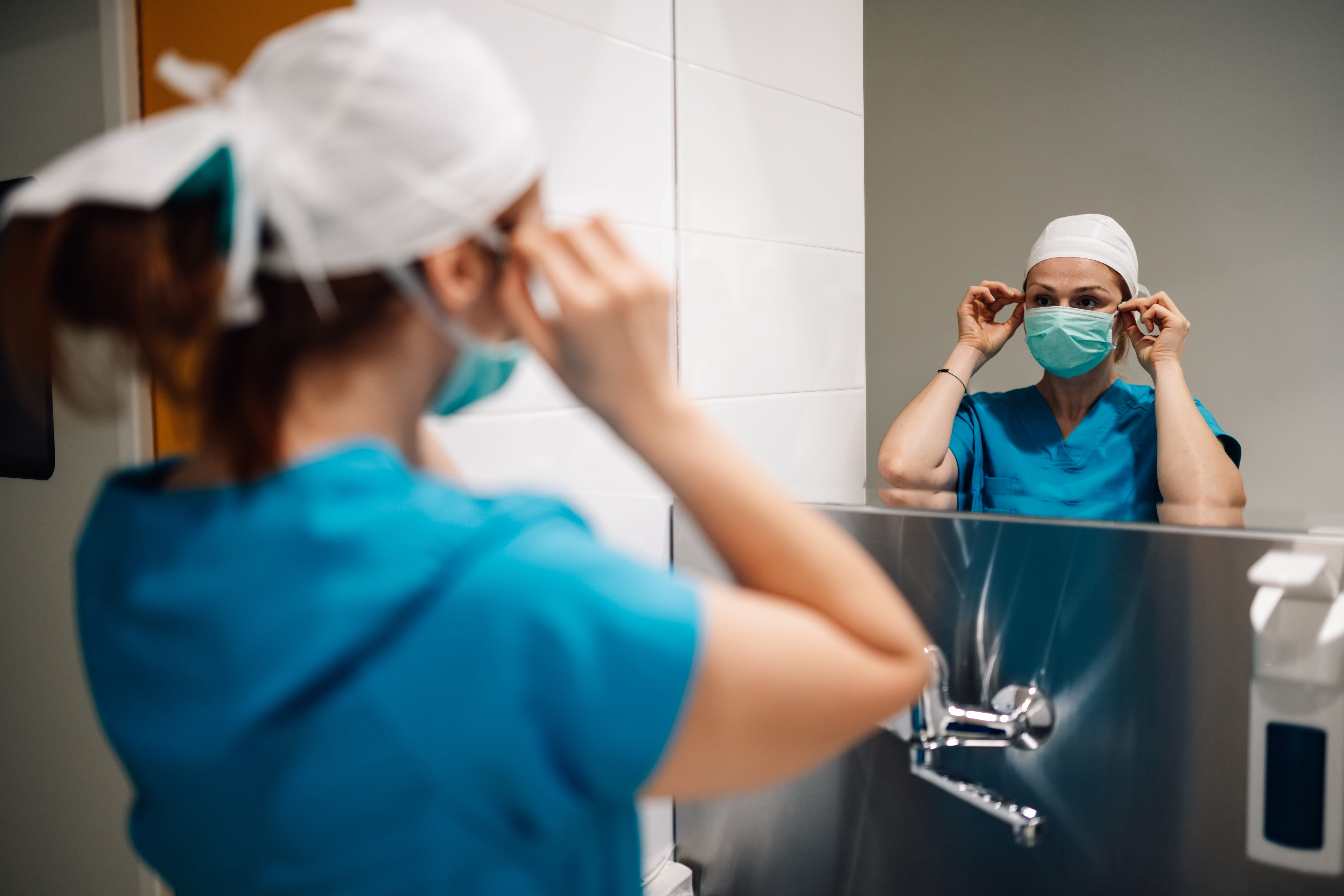
Infection control nurses may work away from the bedside, but the work that they do influences the experience and outcome of nearly every patient. The fact of the matter is, about one in 31 hospital patients has at least one healthcare-associated infection (HAI) on any given day, so the work that infection control nurses do is critical. The job primarily centers around outbreak investigation, data tracking, and protocol building, with the goal of reducing HAI ratings in the facility.
Infection control nurse jobs require clinical judgment as well as data analysis and leadership skills, all of which are developed in a Bachelor of Science in Nursing (BSN) program. Nevada State University’s (NSU) RN to BSN online program builds upon your professional foundation, promoting educational mobility while strengthening community health, critical thinking, and leadership abilities.
What Is an Infection Control Nurse?
An infection control nurse is a registered nurse (RN) who specializes in preventing infection spread across an organization or healthcare facility. While infection prevention nurses play an important role in protecting patient health and well-being, they generally do not manage their own patient load. The bulk of the work is indirect, taking place behind the scenes as part of the larger infection prevention and control team.
The job title may vary based on the facility or organization, with some common titles including:
- Infection prevention nurse
- Infection control practitioner
- Infection preventionists (IP)
IPs take on a unique role in clinical settings, because they create policies and procedures to help healthcare workers reduce the spread of infection and protect patients from acquiring HAIs. These professionals come from a variety of backgrounds, including nursing, epidemiology, public health, microbiology, and lab science. Nurses are especially well-suited to these roles, as they understand unit-level care delivery.
What Does an Infection Control Nurse Do?
On the surface, the goal of infection control nurse jobs is simple: to prevent germs from spreading within a healthcare facility. Their day-to-day tasks, however, are much more varied and complex. Infection prevention nurses must engage in ongoing observation and regularly collect data so they can identify infection patterns within the facility. They use evidence-based strategies to educate healthcare professionals, advise administrators, and provide patients with a safe and comfortable environment.
Key Responsibilities of an Infection Prevention Nurse
Exposure to the germs that cause HAIs can occur through unclean hands, hospital equipment that hasn’t been properly sanitized, or improper healthcare procedures. All the responsibilities of an infection prevention nurse are related to preventing the four main HAIs, such as central line-associated bloodstream infection (CLABSI), catheter-associated urinary tract infection (CAUTI), surgical site infection (SSI), and ventilator-associated pneumonia.
The key responsibilities of an infection prevention nurse are:
- Epidemiology and surveillance methods
- Evidence-based practice and research interpretation
- Quality improvement and safety science
- Data literacy and healthcare informatics
- Leadership, education, and influence without direct authority
- Policy development and regulatory awareness
- Antibiotic stewardship
- Construction and sterilization consulting
In all infection control nurse jobs, professionals follow National Health Safety Network (NHSN) practices and current CDC guidance to protect healthcare workers and patients from HAIs.
Where Infection Control Nurses Work
Across all healthcare settings, administrators and providers are focused on providing patients with safe and effective care in clean facilities, which is why infection control nurses may find employment in many different environments. Common workplace settings include:
- Hospitals
- Ambulatory surgery centers
- Long-term care and skilled nursing facilities
- Dialysis clinics
- Correctional health facilities
- Public health departments
For the most part, infection control nurse jobs are non-shift roles with a typical weekday schedule, making them more predictable than traditional registered nursing roles.
Infection Control vs. Infectious Disease Nursing Roles
Frequently, the infection control and infectious disease nurse job titles get confused, but there are distinct differences between these two professional pathways.
| Role | Focus | Typical Education |
|---|---|---|
| Infection Control Nurse | Preventing HAIs in clinical settings | BSN preferred, additional credentials may be valuable |
| Infectious Disease Nurse | Providing direct patient care for individuals with infectious diseases | BSN preferred, additional credentials may be necessary to specialize |
| Infectious Disease Nurse Practitioner | Diagnosing and treating patients with infectious diseases | MSN or DNP needed to become licensed as a Nurse Practitioner, additional credentials may be needed to specialize |
While infection control nurses do not usually provide bedside care, an infectious disease nurse directly cares for patients who have been diagnosed with HIV, tuberculosis, C. diff, and other infectious diseases. Keep in mind that there is no separate infectious disease nurse practitioner license. Nurse practitioners certify in a population focus, and then subspecialize through practice and advanced credentials. For instance, a nurse practitioner may work to earn the HIV Specialist designation to become an infectious disease nurse practitioner.
How to Become an Infection Control Nurse
Nurses who are passionate about infection prevention and control can prepare for these job opportunities through education, clinical experience, and professional development.
This step-by-step guide will help you learn how to build the credentials and qualities needed for infection control nurse jobs:
Step 1: Earn a Nursing Degree and RN License
You will need to be a licensed registered nurse (RN) to practice as an infection control nurse. To do that, you need to earn an Associate Degree in Nursing (ADN) or a BSN degree. Regardless of whether you earn an ADN or BSN degree, you will have to sit for and pass the NCLEX-RN exam to become licensed to practice. Depending on the state where you plan to work, there may be additional requirements to practice as an RN.
Step 2: Build Clinical Experience
Even though infection control nurses do not provide patients with direct bedside care, they still need clinical experience to build the foundation needed for this complex work. Through clinical experience, you will develop a better understanding of workflow in care-based settings and learn to recognize patterns. Useful clinical backgrounds may include critical care, medical-surgical care, emergency care, or long-term care. For the most part, employers are looking for infection control nurses who have at least one or two years of clinical experience to effectively transition into this specialty area.
Step 3: Complete Your BSN
The ADN degree provides nurses with a strong clinical foundation for providing basic bedside care, and it accelerates entry into the workforce. However, the BSN is considered to be the emerging baseline for registered nursing positions, particularly specialty roles. Pursuing an RN to BSN online program can allow you to expand your clinical expertise in key specialty areas that are relevant to infection prevention and control, such as epidemiology, statistics, research literacy, population health, and leadership.
Step 4: Pursue Certification
Certification may be preferred in some infection control nurse jobs. Certification comes from the Certification Board of Infection Control and Epidemiology (CBIC), not the Association for Professionals in Infection Control and Epidemiology (APIC). The two organizations do work together, but CBIC offers the premier certifications for this specialty area.
The three credentials include:
- Associate–Infection Prevention and Control (a-IPC) — This has no education or job requirements and is an excellent pathway for gaining specialized knowledge and skills.
- Certified in Infection Control (CIC) — This requires a post-secondary health degree, and involves one year of full-time work or 3,000 hours over three years. It is best if direct infection and prevention control responsibilities are included in your job description.
- Long-Term Care Certification in Infection Prevention (LTC-CIP) — This is a credential focused on long-term care that can help you further specialize in infection prevention and control based on a specific patient population.
All certifications are valid for five years, and there are renewal requirements in place at all levels.
The Regulation Behind the Demand
According to federal regulation 42 CFR 483.80, every Medicare or Medicaid-participating long-term care facility must designate at least one infection prevention nurse. The requirements for this role are:
- Primary professional training in nursing or a related field
- Qualified by education, training, experience, or certification
- Works at least part-time
- Completed specialized infection prevention and control training
- An active member of the facility’s quality assessment and assurance committee
Note that nursing is the first qualifying background the regulation names. There are thousands of facilities across the country that must fill the role, highlighting the structural demand for this position. Contrary to popular belief, it’s not a role that is subject to outbreak-driven demand.
Why a BSN Matters for Infection Control Nurse Jobs
Essentially, infection prevention is applied population health inside a clinical facility or healthcare building. In this role, you are reducing risk across thousands of encounters, not just caring for one patient at a time. A BSN matters because it builds the critical thinking, applied research and clinical reasoning skills needed in this job.
Key Skills Developed in a BSN Program
The BSN builds the following relevant skills for infection prevention and control nursing jobs:
- Epidemiology and surveillance
- Evidence-based practice
- Quality improvement and safety science
- Data literacy and informatics
- Leadership and influence without authority
- Policy and regulatory awareness
Building an understanding of how to enact influence without authority is necessary, especially if you want to work in infection prevention. For example, IPs rarely supervise the people whose behavior they need to change. So, if you are going to persuade a surgical team to follow infection prevention protocols, you will need credibility, evidence, and strong communication skills.
Infection Control Nurse Salary and Job Outlook
The U.S. Bureau of Labor Statistics (BLS) does not publish separate wage data for infection control nurses, so RN figures are used as the benchmark. In May 2024, the reported median annual salary for registered nurses was $93,600, with those working in government earning a median salary of $106,480 and those in hospitals earning a median salary of $97,260. Infection control nurses usually earn a higher salary, because they often work in quality departments or as part of public health agencies.
The outlook for RNs is strong, with 5% job growth anticipated between 2024 and 2034, which is faster than average. There is expected to be about 189,100 job openings annually over the course of the next decade.
Begin Your Path Toward Becoming an Infectious Prevention Nurse at Nevada State University
The BSN degree opens the door to infection control nurse roles, where you will be able to use your existing clinical knowledge to protect patients at scale, all while enjoying a more predictable schedule. Nevada State University (NSU) offers an RN to BSN online program that features fully online coursework. It can be completed in as little as 12 months for under $11,000 and is CCNE accredited, making it an excellent option for nurses focused on career acceleration. Coursework emphasizes evidence-based care, community health, patient safety and leadership, all of which are necessary in infection prevention work.
Request more information about NSU’s RN to BSN online program.
Sources
https://nevadastate.edu/program/rn-bsn/
https://www.cdc.gov/healthcare-associated-infections/about/index.html
https://www.cdc.gov/nhsn/psc/index.html
https://www.cdc.gov/infection-control/hcp/core-practices/index.html
https://www.ecfr.gov/current/title-42/chapter-IV/subchapter-G/part-483/subpart-B/section-483.80
https://www.bls.gov/ooh/healthcare/registered-nurses.htm
https://aahivm.org/hiv-specialist/
https://pmc.ncbi.nlm.nih.gov/articles/PMC8528055/
https://apic.org/news/who-are-infection-preventionists/
https://www.nclex.com/register.page
https://www.cbic.org/CBIC/Get-Certified/Get-Started.htm
https://learnipc.apic.org/wp-content/uploads/2023/01/APIC_LTC-CIP_AYBToolkit_v2.pdf
https://learnipc.apic.org/wp-content/uploads/2023/04/APIC_CIC_AYBToolkit_final.pdf
https://learnipc.apic.org/wp-content/uploads/2024/04/APIC_aIPC_AYBToolkit_final.pdf